

|
Jean-Dominique Gascuel
|
|
Research
Publications
Here's a list of my 6 last papers:
2022
Poster communications
-
- auteur
- Olivier A.J. Martin, Denis Faure-Vincent, Jean-Dominique Gascuel, Sébastien Schmerber, Alina Voda, Pascal Bellemain
- titre
- Therapeutic effects of large-field visual virtual immersion on balance control in unilateral vestibular patients
- article
- ISPGR 2022 - International Society of Posture and Gait Research, Jul 2022, Montréal, Canada. pp.1-1
- resume
- BACKGROUND and AIMS. During balance rehabilitation, automatic visual-vestibular compensations occur to reduce the patients? visual dependence due to the vestibular inhibition suppression. This study presents the positive therapeutic effects of interactive protocols based on immersive virtual reality (VR) that restore the reciprocal visual-vestibular inhibition on a short period of two months, and the use of an identification procedure to characterize the relationship between visual stimulation features and the adaptive equilibrium parameters associated to the balance enhancement. METHODS. Included in an 8 weeks clinical trial, nine unilateral vestibular patients (42-80 y.o) were immersed into structured large-field visual virtual flows, whose the dynamic constraints and complexity (scroll, radial and rotation visual pattern, stimulation speed, and gaze anchoring) increase throughout the therapeutic session. The analysis focus on the gaze behavior, feet center-of-pressure trajectory (CoPT) and disequilibrium indicators. RESULTS. The results show that the balance perturbations and the associated compensatory postural strategies are intensified (increasing of the CoPT and ID values) related to the complexity of the virtual pattern and speed, but progressively decrease significantly throughout the sessions, for all the stimulation conditions and scenarios. The methodical repetition of the virtual scenarios, associated to the consistent practice through sessions, strengthened the adaptive balance improvement. Data indicates the balance recovery and a patients? self-confidence due to the reduction of the visual dependence boosted by the visual-vestibular reverse compensation. CONCLUSION. At a clinical level, our results demonstrate the real and rapid effectiveness of the large-field visual immersion on condition of controlled and repetitive virtual scenario. Despite the lack of long-term effects (reported by patients on a six months period) requiring periodic booster sessions, new rehabilitation strategies including virtual visual immersions have to be preferred comparing to standardized rehabilitation protocols (uncontrolled optokinetic stimulation). At a neuro-functional level, the visual-vestibular-motor adaptation despite the persistence of vestibular deficits indicates the relative reweighting of the visual-vestibular sensory inputs for a functional reciprocal inhibition restoration. New questions on the neural basis of the visual-vestibular plasticity for balance control will be addressed. Finally, our study corroborate the proof of concept of controlled VR-rehabilitation, with experimental, practicable and clinical validation.
- Accès au texte intégral et bibtex
-


2021
Other publications
- auteur
- Olivier A.J. Martin, Alina Voda, Paulo Naves-Neto, Denis Faure-Vincent, Jean-Dominique Gascuel, Sébastien Schmerber
- titre
- VR-based rehabilitation benefits for sensory compensation and balance recovery in vestibular patients. Journée de l?Axe Neurosciences Cliniques - Session "Handicap et Qualité de Vie". CHU Grenoble-Alpes, Grenoble, France. Déc. 2021. [oral presentation]
- article
- 2021
- Accès au bibtex
-
2019
Conference papers
-
- auteur
- Alina Voda, Olivier A.J. Martin, Paulo Rodrigues Naves Neto, Jean-Dominique Gascuel, Sebastien Schmerber
- titre
- Visual-vestibular compensation in balance recovery: A transfer function model-based analysis
- article
- FOSBE 2019 - 8th IFAC Conference on Foundations of Systems Biology in Engineering, Oct 2019, Valencia, Spain. pp.1-6
- Accès au texte intégral et bibtex
-

2016
Conference papers
-
- auteur
- Beibei Wang, Jean-Dominique Gascuel, Nicolas Holzschuch
- titre
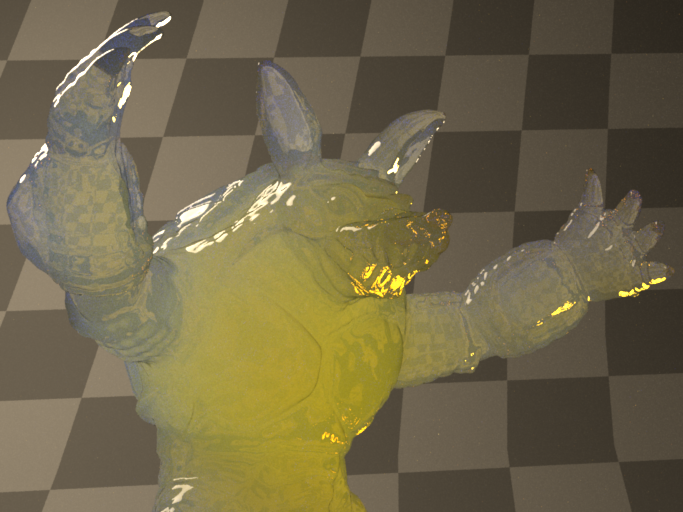
- Point-Based Light Transport for Participating Media with Refractive Boundaries
- article
- Eurographics Symposium on Rendering 2016 - Experimental Ideas & Implementations, Jun 2016, Dublin, Ireland. ⟨10.2312/sre20161216⟩
- resume
- Illumination effects in translucent materials are a combination of several physical phenomena: absorption and scattering inside the material, refraction at its surface. Because refraction can focus light deep inside the material, where it will be scattered, practical illumination simulation inside translucent materials is difficult. In this paper, we present an a Point-Based Global Illumination method for light transport on translucent materials with refractive boundaries. We start by placing volume light samples inside the translucent material and organising them into a spatial hierarchy. At rendering, we gather light from these samples for each camera ray. We compute separately the samples contributions to single, double and multiple scattering, and add them. Our approach provides high-quality results, comparable to the state of the art, with significant speed-ups (from 9× to 60× depending on scene complexity) and a much smaller memory footprint.
- DOI
- DOI : 10.2312/sre20161216
- Accès au texte intégral et bibtex
-

2013
Journal articles
-
- auteur
- Nicolas Holzschuch, Jean-Dominique Gascuel
- titre
- Double- and Multiple-scattering Effects in Translucent Materials
- article
- IEEE Computer Graphics and Applications, 2013, Special Issue on Scattering: Acquisition, Modeling and rendering, 33 (3), pp.66-76. ⟨10.1109/MCG.2013.19⟩
- resume
- Some materials, such as coffee, milk or marble, have a soft translucent aspect because of sub-surface scattering: light enters them, is scattered several times inside before leaving in a different place. A full representation of sub-surface scattering effects in illumination simulation is computationally expensive. The main difficult comes from multiple scattering events: the high number of events increases the uncertainty on the result, forcing us to allocate more time for the computations. In this paper, we show that there is a strong correlation between the surface effects of multiple scattering inside the material and the effects after just two scatter events. This knowledge will help in accelerating multiple scattering effects. We exploit this knowledge to provide a model and implementation for fast computation of double-scattering events, using a precomputed density function stored in a compact way.
- DOI
- DOI : 10.1109/MCG.2013.19
- Accès au texte intégral et bibtex
-
Conference papers
- auteur
- Olivier A.J. Martin, Jean-Dominique Gascuel, Henri Payno, Sebastien Schmerber
- titre
- Flexibility of sensorimotor integration in visual virtual immersion. Case of vestibular patients
- article
- ACAPS 2013 - 15ème Congrès international de l'Association des Chercheurs en Activités Physiques et Sportives, ACAPS, Oct 2013, Grenoble, France
- Accès au bibtex
-
»Complete list of my publications
»Complete list of images associated to my publications
Curriculum Vitae
Teaching